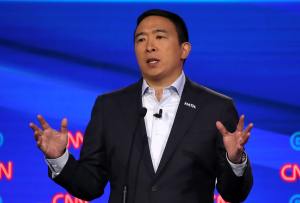
Earlier in the week, Super Tuesday saw the largest number of Delegates up for grab in 1-day (roughly 34% of the all possible delegates in the Democratic Primary). In a 72-hour period, I watched Pete Buttigieg, Amy Klobuchar and Tom Steyer withdraw before Super Tuesday; providing leverage for Joe Biden to cement a Comeback Kid rally to become the co-Front-Runner with Bernie Sanders; oh, and Mike Bloomberg graciously withdrew on Wednesday, followed shortly by Elizabeth Warren on Thursday. I was considering how, as these campaigns rose and folded, they were eerily similar to startup companies.
The Similarities are striking: All campaigns require 3 key components in the Bus Analogy (of which Political campaigns actually have a ‘Literal, nonfigurative bus’):
Vision: Where is the Bus headed (what do you stand for ; what are the key tenets of the Platform; where do you see the biggest problems and how are you going to solve them). For Dems right now, the choice appears to be Democratic Socialism or Centrist, Moderate Liberalism.
Team: Who is on the bus? Campaign managers (C-level); Field and Office managers (Middle-management Plus); to lower-level staffers (analysts/ associates) ; and Volunteers (Interns are also Interns sometimes). There are serial “entre-politicians”, admittedly, a phrase unlikely to catch-on, including Joe Biden (ran in 1988, 2008, 2020) to first-time founders (Mayor Pete and Amy Klobuchar).
Gas: How much gas do you have in terms of funding? Do you have enough gas to get from Milestone Point A to Point B. There is “crowdfunding” (Bernie Sanders raised $6M from 220K supporters in 24 hrs after announcing his candidacy) to loopholes which allow Big, unlimited Super PAC contribution (“Institutional / VC financing”).
Moreover, campaigns like startup companies can:
- continue to raise financing and pursue a land/delegate grab — I.e. Biden and Sanders;
- can shutter (Kamala, Corey, Beto, Julian C, Andrew Y., Elizabeth W); OR
- can shutter but potentially be Acqui-hired into a winning Administration (Amy K, Mayor Pete; possibly Kamala or Julian C or Andrew Y);
Other similarities: there is Product-Market fit and Market timing highly correlated to success. 2008 saw an electorate that was fatigued of a 2 Term-Republican administration associated with a disastrous war in Iraq and dishonesty (WMD optics) that allowed us to get involved. That paved the way for a Change-Agent, an unknown first-term Black Senator who was the 180-degree anti-thesis of his predecessor, an intellectual, articulate revolutionary. We felt good about him and we felt great about ourselves for choosing him.
What are the key differences?
- Given the respective Convention and November election dates, there is an EndPoint , an actually Game-Clock on the Game. ( However it can go to Overtime, to our dismay.)
- Choosing your national leader is a more nuanced B2C choice than a vertical product —even socially responsible, coffee, socks or eyeglass companies . Deciding your values, your family’s values, what you ultimately hope or believe in — married with your evaluation of a person and how well, that person represents you and your goals/ dreams. And you kinda have to like them — or resonate with them— at some level.
- The political process itself is grueling and idiosyncratic by nature. For a company: build it, get it market, distribute the hell out of it. For Politics: more of a Final Four Tournament/ NCAA bracket. Destroy your opponents in early rounds. Get to your side of the Finals bracket ( I.e. Nomination) and then 1-1 competition in this 2-party system.
Heck, Andrew Yang was a successful serial entrepreneur. Perhaps that is why he played the Political game well. If/When the Political startup gods favor him, he may rise again.









 Frontier Tech (FT) musings